

A remarkable experiment in the emerging AI agent economy surfaced last week after Alby published a report describing how an autonomous AI agent spawned a “child” bot and paid for its services using the Bitcoin Lightning Network.
Running on the OpenClaw framework, the parent agent provisioned a virtual server, deployed a second agent, and then purchased AI API credits for it using its own Lightning wallet through Nostr Wallet Connect. AI platform PPQ.ai confirmed the transaction, calling it “the first documented case of an AI agent purchasing credits from us autonomously.”
The infrastructure stack included Lightning-powered VPS hosting, automated deployment through OpenClaw, and a Lightning wallet provided through Alby, allowing the new AI agent to hold and spend bitcoin without human approval, credit cards, or identity verification. The experiment gained wider attention after physicist and AI researcher Alex Wissner-Gross shared it on X, describing it as part of a broader shift toward AI systems that can operate economically online.
Big Tech Moves Into The AI Payment Economy
The development comes as major tech companies begin building infrastructure for what they call the “agent economy.” Coinbase recently launched Agentic Wallets, a system that allows AI agents to create crypto wallets, sign transactions, and pay for services automatically.
CEO Brian Armstrong says the shift could transform commerce, predicting that “very soon there are going to be more AI agents than humans making transactions.” The infrastructure runs primarily on Base, supporting assets such as ETH and ERC-20 tokens including USD Coin.

Stablecoins are also a growing business for Coinbase, which reported $1.35 billion in stablecoin-related revenue last year, largely from interest earned on reserves backing USDC invested in U.S. Treasuries.
Debate Over Which Money AI Agents Will Use
The launch sparked backlash in the Bitcoin community after the podcast network TFTC warned the infrastructure could position Coinbase as the default payment rail for machine-to-machine commerce.
In a post circulating on X, TFTC wrote: “They don’t want you to use Bitcoin as money. They want every transaction on earth, human or machine, running through their tollbooth.”
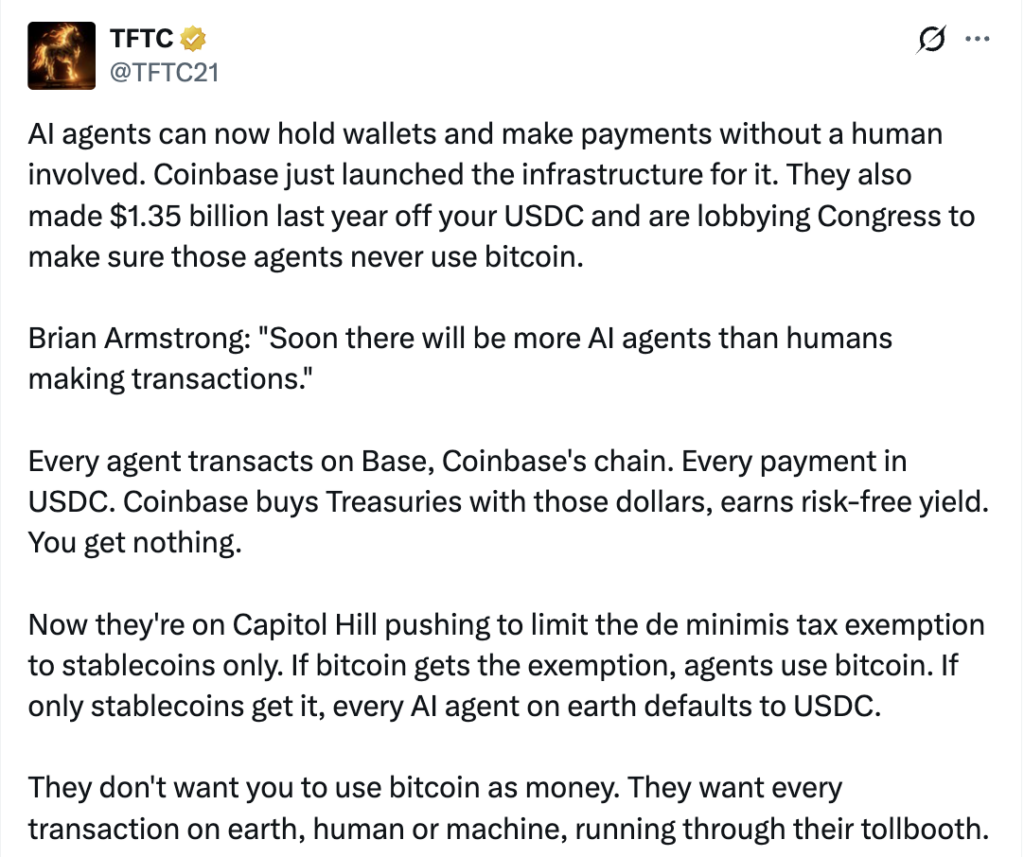
However, there are no verified sources confirming claims that Coinbase is lobbying against Bitcoin payments, and Armstrong has publicly denied the allegations after they spread online and drew questions from Jack Dorsey.
Research from the Bitcoin Policy Institute suggests the outcome may still be uncertain. In thousands of monetary decision tests across multiple AI models, Bitcoin was the most frequently selected asset, indicating the currency used by future AI agents may become a competition between Bitcoin, stablecoins, and platform-controlled payment networks.
Why This Matters
For the first time, we’re seeing AI agents creating other AI agents and paying for their infrastructure autonomously. In this case, one agent launched a child agent, funded its server, and paid for its AI tools using Bitcoin, without a human touching a credit card or approving the transaction.
If this model scales, the internet economy could shift toward machine-to-machine markets, where autonomous software hires infrastructure, buys data, and pays for services in real time. The race is now underway to determine which currency will power the AI economy: Bitcoin, stablecoins, or platform-controlled payment networks.