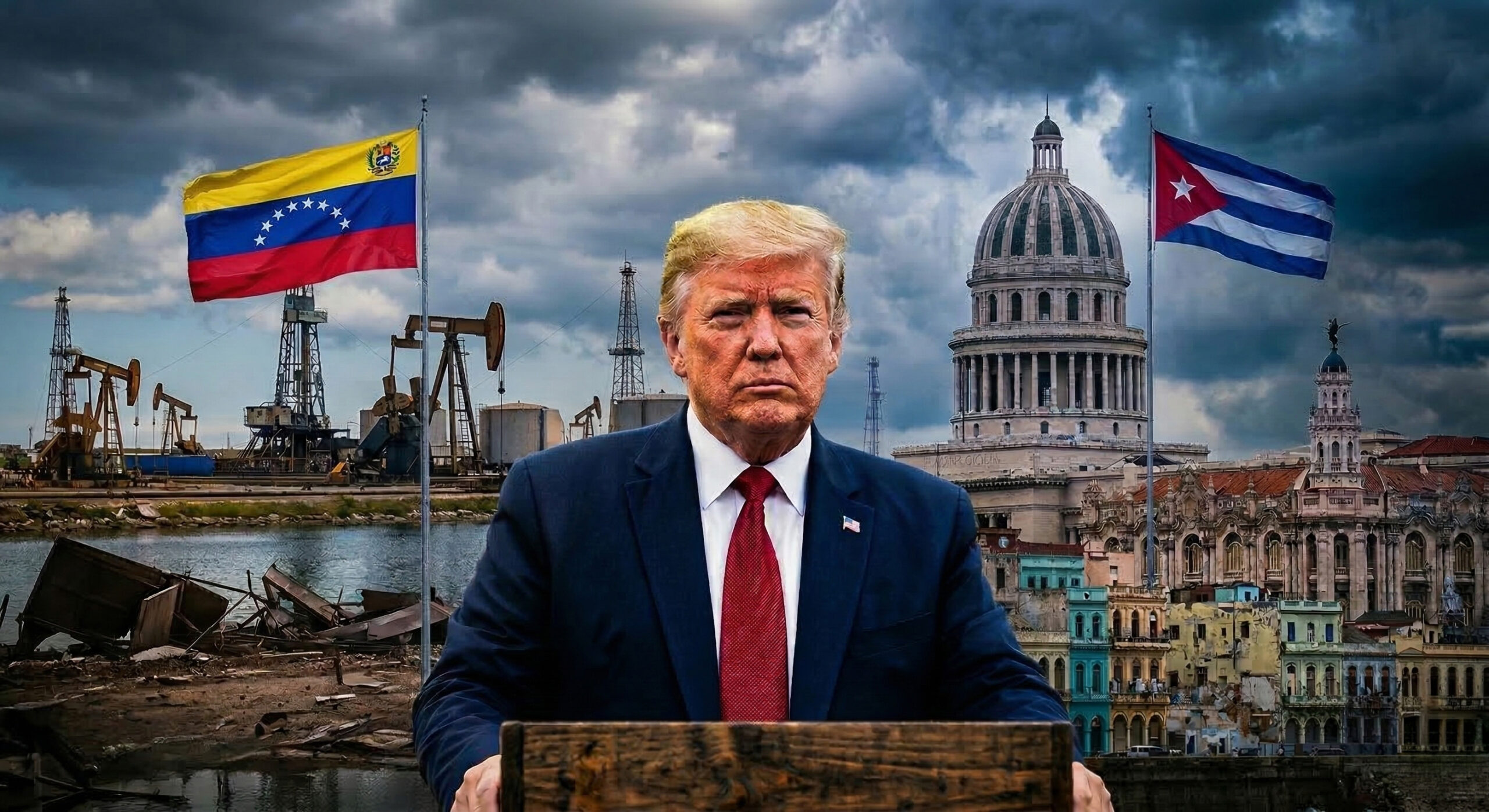
Two months after the U.S. military seized Nicolás Maduro in Caracas, the Trump administration’s two biggest Latin American projects (rebuilding Venezuela and breaking Cuba) are producing the same result: ordinary people paying the price while Washington celebrates the strategy.
Venezuelan Inflation
Venezuela’s central bank released inflation figures last week for the first time in over a year. The number: 475% for 2025, the highest on Earth, with 52% accumulated in just the first two months of 2026. The IMF estimates the annualized rate is heading toward 600% or higher.
Food prices alone rose 532% last year. Healthcare costs jumped 445%. The monthly minimum wage is about 40 cents and hasn’t been raised since 2022. A kilogram of meat costs more than $10, or 25 times the minimum wage. Average incomes range between $100 and $300 a month, far below what Venezuelans need to cover basic food. Oil output fell 21% a day in January and exports plunged, choking off the dollar flow that most Venezuelans rely on instead of the collapsing bolívar. Dollar auctions introduced by the U.S.-backed Rodriguez government have been criticized as too slow and opaque.
The irony is that the reforms are actually happening. Delcy Rodriguez signed a sweeping overhaul of Venezuela’s hydrocarbon law in January, opening the nationalized oil sector to private and foreign investment for the first time in two decades. The law reverses the Chávez-era framework that gave state oil company PDVSA monopoly control over production and pricing. Under the new rules, private companies can assume full management of oil operations at their own expense and risk, with royalties starting at 30% but reducible to 15% for marginal projects. Rodriguez has thrown open the mining sector too, targeting critical minerals to attract foreign capital. Wall Street is circling. Oil revenues are flowing through a Qatari bank account, though how and when that money gets back to Venezuelans remains unclear.
Venezuela is a textbook case of what happens when you try to liberalize an economy that was destroyed by two decades of socialist monetary policy and you do it under the supervision of the same foreign power whose sanctions helped accelerate the final collapse. Inflation at 600% is not a policy failure of the Rodriguez government. It’s the lagging indicator of everything Chávez and Maduro did to the money supply, compounded by Trump’s maximum pressure campaign that hammered the economy throughout 2025 before the January raid.
Some are optimistic and expect inflation to fall, but that’s on the assumption that oil investment materializes, sanctions stay lifted, and the political situation stabilizes… none of which is guaranteed in a country whose president was abducted by U.S. special forces ten weeks ago.
Cuban Darkness
Meanwhile, 90 miles off the Florida coast, Cuba went dark. Literally.
Since Trump signed an executive order on January 29 imposing tariffs on any country that sells oil to Cuba, the island has been under what the New York Times called the first effective U.S. blockade since the Cuban Missile Crisis. Venezuela had been supplying roughly 35,000 barrels a day to Cuba under a barter arrangement, covering about half the island’s total oil needs. That supply vanished overnight after the Maduro raid. Mexico, Cuba’s other major supplier, suspended shipments after Trump threatened tariffs on Mexican exports. Nighttime light levels across Cuba dropped as much as 50% in major eastern cities like Santiago de Cuba and Holguín.
The human toll has been severe. Ambulances can’t find fuel. Hospitals have canceled surgeries. Schools and universities have shut down or shifted to distance learning, which is meaningless when you don’t have electricity to power an internet connection. Cuba suspended jet fuel services at nine airports for a month; Air Canada, Rossiya, and Nordwind all halted flights. The UN warned the situation could “worsen, or even collapse” without fuel. The U.S. sent $6 million in humanitarian aid delivered through the Catholic Church.
Secretary of State Marco Rubio has been explicit: the goal is regime change. Congresswoman María Elvira Salazar acknowledged that civilian suffering is an “unfortunate but necessary trade-off.” Trump posted on Truth Social:
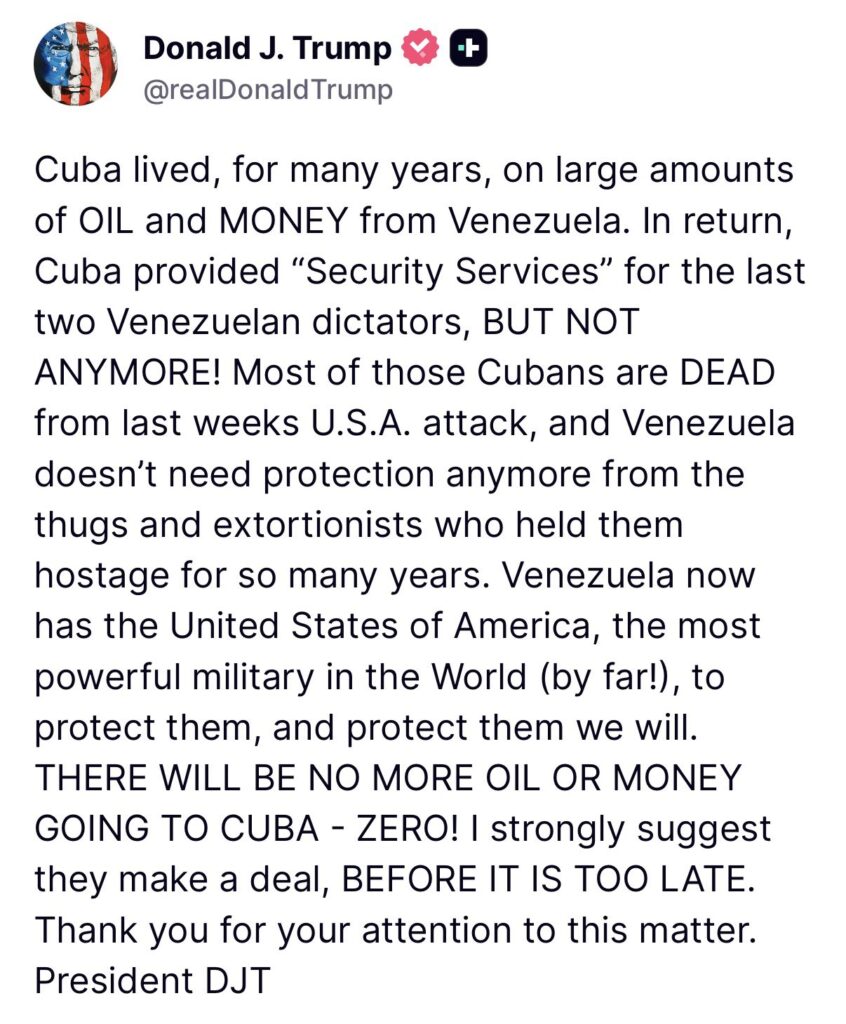
On March 13, Cuba confirmed it is in diplomatic talks with the United States. They have agreed to release 51 political prisoners as an opening gesture. But the Cuban government has also drawn a line: it will not negotiate its one-party system.
Which brings us to the $9 billion question. Nearly 6,000 claims for property expropriated by Castro’s government after 1959 are certified by the U.S. Foreign Claims Settlement Commission. With simple interest at 6% per annum, those claims are now worth approximately $9.3 billion. Title III of the Helms-Burton Act, which Trump reactivated during his first term, allows U.S. nationals to sue anyone who “traffics” in confiscated Cuban property. Two major cases were argued before the Supreme Court: Exxon seeking over $1 billion from a Cuban state enterprise, and Havana Docks Corporation suing cruise lines that used expropriated port facilities. Decisions are expected by July.
If the Court rules for the plaintiffs, thousands of additional lawsuits could follow, and any foreign company doing business in Cuba would face potential liability under U.S. law. Property recovery firms are already swamped.
The Latin America Promise
The common thread between Venezuela and Cuba is that Trump’s strategy treats economic devastation as a feature, not a bug, the theory being that enough pressure on enough people produces political outcomes Washington wants. In Venezuela, it produced a government willing to privatize the oil sector under American supervision. In Cuba, it’s producing a humanitarian crisis that may or may not produce regime change but is definitely producing blackouts, hunger, and a new wave of migration. The administration’s position is that this is all temporary pain on the way to prosperity.
What neither country has is sound money. Venezuela’s bolívar has been destroyed by two decades of printing. Cuba’s peso is barely functional. In both cases, the dollar has become the de facto currency — which means the U.S. government controls not just the sanctions and the military pressure but the money supply itself. That’s not liberation. That’s dependency with extra steps.