
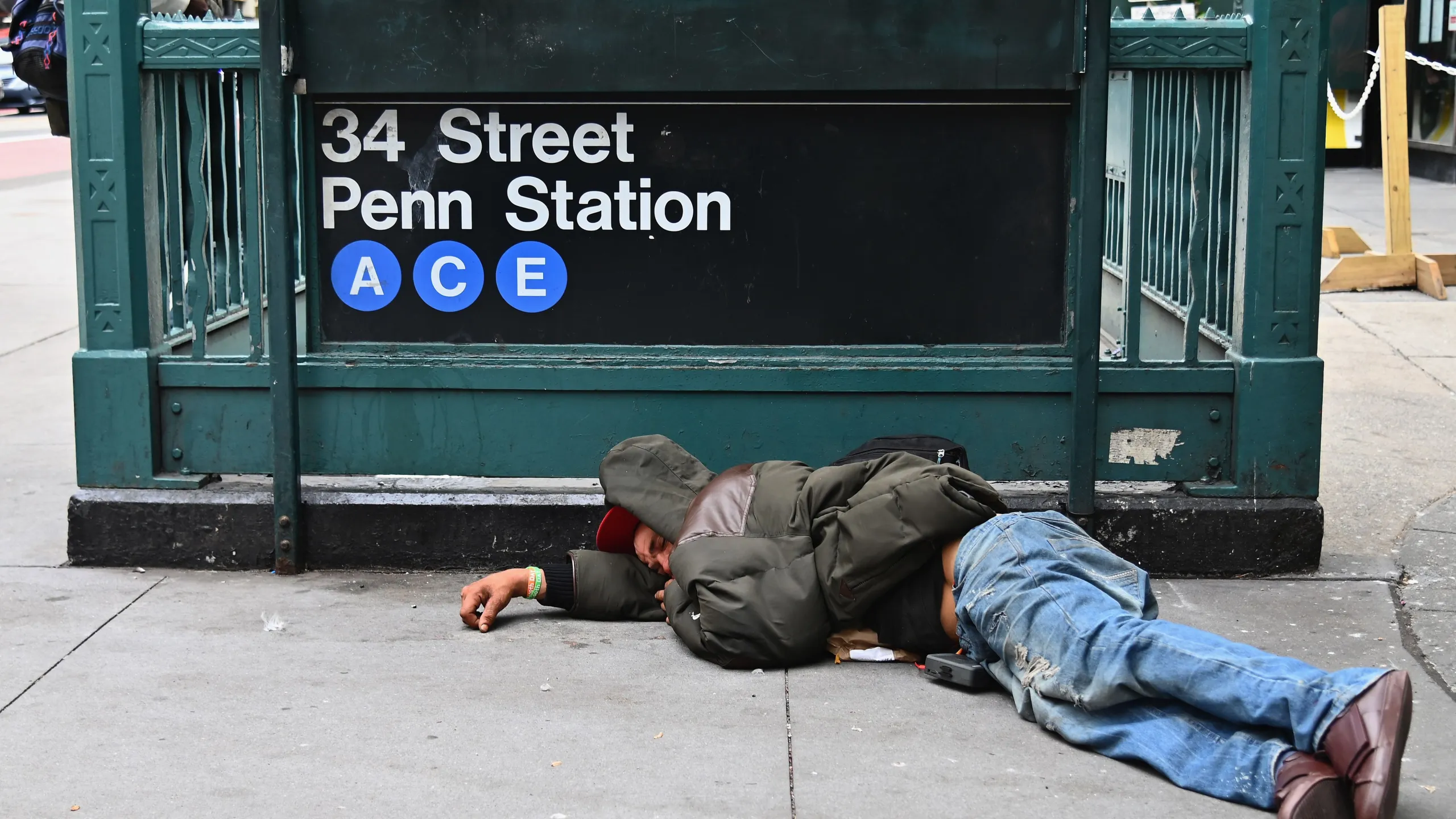
New York City spent $81,750 per unsheltered homeless person in fiscal year 2025, up from $28,000 just six years earlier. That’s a 262% increase in spending on a population that grew 26% over the same period. The report released last week also found that total spending on the city’s Street Homeless Solutions division more than tripled from $102 million in 2019 to $368 million in 2025. The unsheltered population went from 3,588 to 4,505. More money, more homeless. The city is now spending roughly the equivalent of New York’s median household income ($81,228 according to the 2024 Census) on each person living on its streets, and the number of people living on those streets keeps going up.
That $368 million, by the way, is just the street homeless budget. It doesn’t include the city’s broader shelter system, which houses over 100,000 people a night and runs through the Department of Homeless Services. It also doesn’t include roughly $500 million a year the city spends separately on supportive housing, mental health co-response teams, NYPD homeless-clearing operations, and other programs that touch this population but are budgeted through different agencies.
The $81,000 figure is just the visible tip of a spending structure that stretches across nearly every corner of city government.
Where does the money go? The comptroller’s report doesn’t fully answer that question, and that’s part of the problem. DHS has consolidated its costs for outreach, low-barrier shelter beds, Safe Haven beds, stabilization beds, and drop-in centers into a single budget line, making it nearly impossible to assess what any individual program costs or whether it works. The data doesn’t distinguish between permanent housing placements and transitional ones, doesn’t track how long people stay housed after placement, and doesn’t report outcomes by vendor. The city counts bodies moved but doesn’t track whether they stay moved.
This is not a new transparency problem. A 2024 NYC Department of Investigation report on the nonprofit organizations that run the city’s shelter network uncovered what it called “hundreds of governance and compliance concerns.” There’s reported widespread self-dealing, nepotism, and conflicts of interest at dozens of nonprofit shelter operators.
Into this environment walks Mayor Zohran Mamdani, who took office January 1 and has already made two headline-grabbing moves. First, he signed a $1.86 billion, three-year contract with the Hotel Association of New York City Foundation to keep hotel rooms available as emergency shelter for homeless families. The deal was inked despite the migrant crisis that originally drove the city into hotels having largely subsided. DHS says actual spending will fall below the contract ceiling, but the structure of the deal locks the city into paying the hotel industry for standby capacity whether or not it’s used at full scale.
Second, while signing the hotel deal, Mamdani announced the closure of Manhattan’s largest men’s shelter, the 250-bed city-owned Bellevue facility on East 30th Street. So the city is shutting a public asset it owns while committing nearly $2 billion to rent private hotel rooms it will never own. After three years and $1.86 billion, the city will have acquired exactly zero permanent housing units.
The pattern is familiar to anyone who has watched government social spending scale: costs compound, bureaucracies expand, the contractor class grows, outcomes stagnate, and accountability becomes structurally impossible because nobody designed the system to measure results. They designed it to measure inputs. New York doesn’t know whether its $81,000 per person is buying anything because it literally cannot track what happens to people after they’re “placed.” It can tell you how many outreach workers it hired and how many beds it funded. It cannot tell you whether homelessness is being reduced or simply managed as a permanent budget line that employs thousands of people whose jobs depend on the problem never being solved.
City government officials have recommended rack outcomes, publish vendor performance, differentiate between permanent and transitional housing in the data. The fact that these are recommendations in 2026, not established practice, tells you everything about how the system actually functions.