Russia has been shutting down mobile internet across entire cities, throttling the most popular messaging apps in the country, blocking nearly 500 VPN services, and herding 100 million people onto a state-built surveillance app.
The Kremlin says it’s about security. The timing says it’s about control.
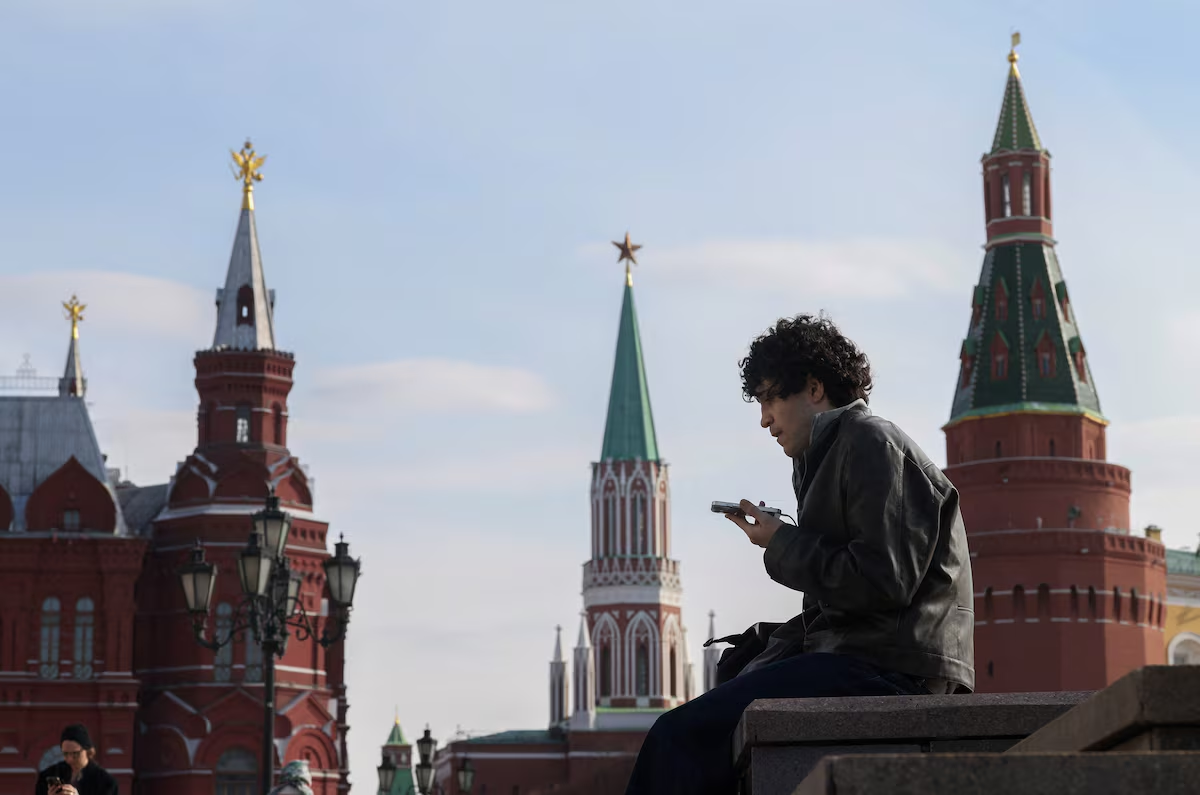
Since early March, large parts of central Moscow have experienced near-total mobile internet blackouts. Residents couldn’t access banking apps, hail taxis, or load maps. Some resorted to carrying cash and printing directions. Demand for walkie-talkies and physical maps spiked. Even the Kremlin had to switch to landline phones.
The official explanation is drone defense. Kremlin spokesman Dmitry Peskov said Ukraine is using “increasingly sophisticated methods for attacks, so Russia needs increasingly technological protection measures.”
But the shutdowns aren’t limited to border regions or military facilities. They’ve spread to cities thousands of kilometers from the front lines. By mid-2025, more than half of Russia’s regions were experiencing regular mobile internet outages. In some districts, mobile internet was unavailable 15 to 20 days per month. Moscow, which had been mostly spared, has now also fallen under the surveillance umbrella.
Mobile internet accounts for 50 to 70 percent of all data transmission in Russia. Shutting it down breaks the economy. Five days of outages cost Moscow businesses $37 to $62 million. Small and medium businesses, which depend on online services and digital communication with customers, have been hit hardest.
The blackouts are the bluntest tool, but there’s a subtler one. When mobile internet goes down, Russia now activates a system that blocks all content except a pre-approved list of government-friendly services: state media, government websites, domestic marketplaces, VK’s social platforms, and taxi and delivery apps. So what looks like a partial restoration of service is actually a filter. You get your internet back, but only the internet the government wants you to see.
Running alongside the shutdowns is a campaign to kill independent messaging. Telegram, the most popular platform in Russia with over 95 million users may be fully blocked by April. WhatsApp was completely blocked on February 11. YouTube, Signal, Discord, Instagram, Facebook – Russians can’t access them either.
As of September 2025, Russians can be fined for “intentionally” searching for extremist content online, including through VPNs. It was the first time Moscow criminalized consuming banned material rather than distributing it.
The replacement for all of this is MAX, a messaging app built by VK, the state-controlled social media company. It has been promoted as the “national messenger,” and since September 2025, it is legally required to be installed on every smartphone and tablet sold in Russia. By March 2026, MAX has 100 million registered users.
What MAX actually does is collect everything. Under Russian law, VK must integrate with the government’s surveillance system. The app gives the security services backdoor access to private conversations, financial transactions, and geolocation data. Security researchers found that MAX contains a module that can detect whether a user is connected to a VPN, what websites are accessible or blocked on their network, and their real IP address. Users cannot disable this monitoring.
The political context makes the security excuse harder to take seriously. Support for continuing the Ukraine invasion has fallen to 25 percent, a record low. The economy is stagnating. The budget deficit is growing. Fiscal burdens on households are increasing. Parliamentary elections are scheduled for September 2026. The Kremlin is not building a firewall against drones. It is building a firewall against its own population, cutting off horizontal communication, preventing the organization of dissent, and forcing 145 million people into a digital ecosystem where the state can see everything and control what anyone is allowed to read, say, or share.
China built its Great Firewall over two decades. Russia is trying to build one in two years, while at war, while the economy contracts, and while the population is already online and accustomed to open platforms. The economic damage is real and escalating. The political logic, from the Kremlin’s perspective, is that the cost of an informed, connected population is higher than the cost of a broken internet. Whether that calculation holds through September is the only question that matters.