
As airstrikes hit Tehran and the regional conflict escalates, Iran’s digital infrastructure appears to be collapsing alongside its financial stability. Blockchain analytics firms report Bitcoin and crypto outflows from Iran’s largest exchange, Nobitex, surged roughly 700% within minutes of the first U.S.–Israeli strikes, as users rushed to move funds out of the country.
At the same time, Iran has plunged into a near-total internet blackout. Internet watchdog NetBlocks says national connectivity has flatlined to about 1% of normal levels, leaving more than 90 million Iranians effectively offline for roughly 100 hours as the conflict intensifies.
That shutdown also appears to have choked off the initial Bitcoin and crypto escape route. Analysts say transaction activity spiked immediately after the strikes, but quickly slowed once connectivity collapsed across the country.
Some observers are watching for signs that people may be turning to offline communication networks. Earlier this year, mesh-based messaging apps like Bitchat saw download spikes across parts of the Middle East during internet disruptions. But there are no confirmed reports yet showing that those networks are being widely used inside Iran during the current blackout.
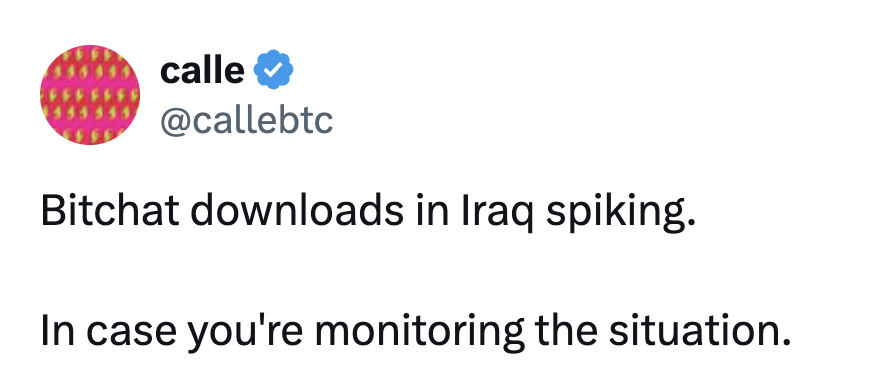
However, Bitcoin and Bitchat developer Calle posted on March 2
“Bitchat downloads in Iraq spiking.
In case you’re monitoring the situation.”
If neighboring countries are seeing increased adoption during the regional crisis, it’s reasonable to assume similar tools may be gaining interest inside Iran, though the blackout itself makes that difficult to verify.