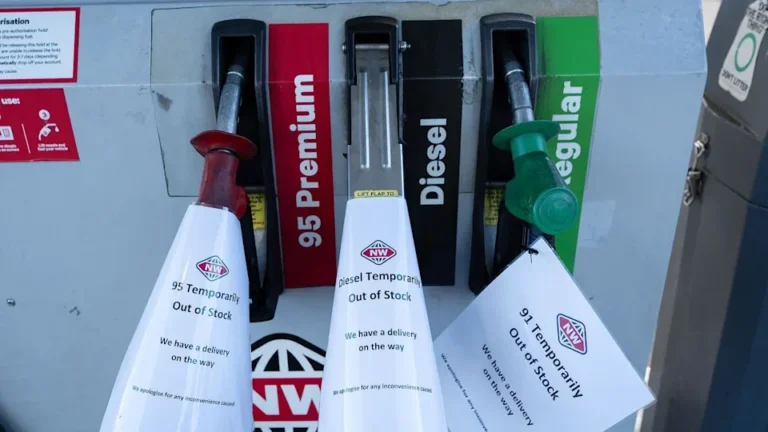
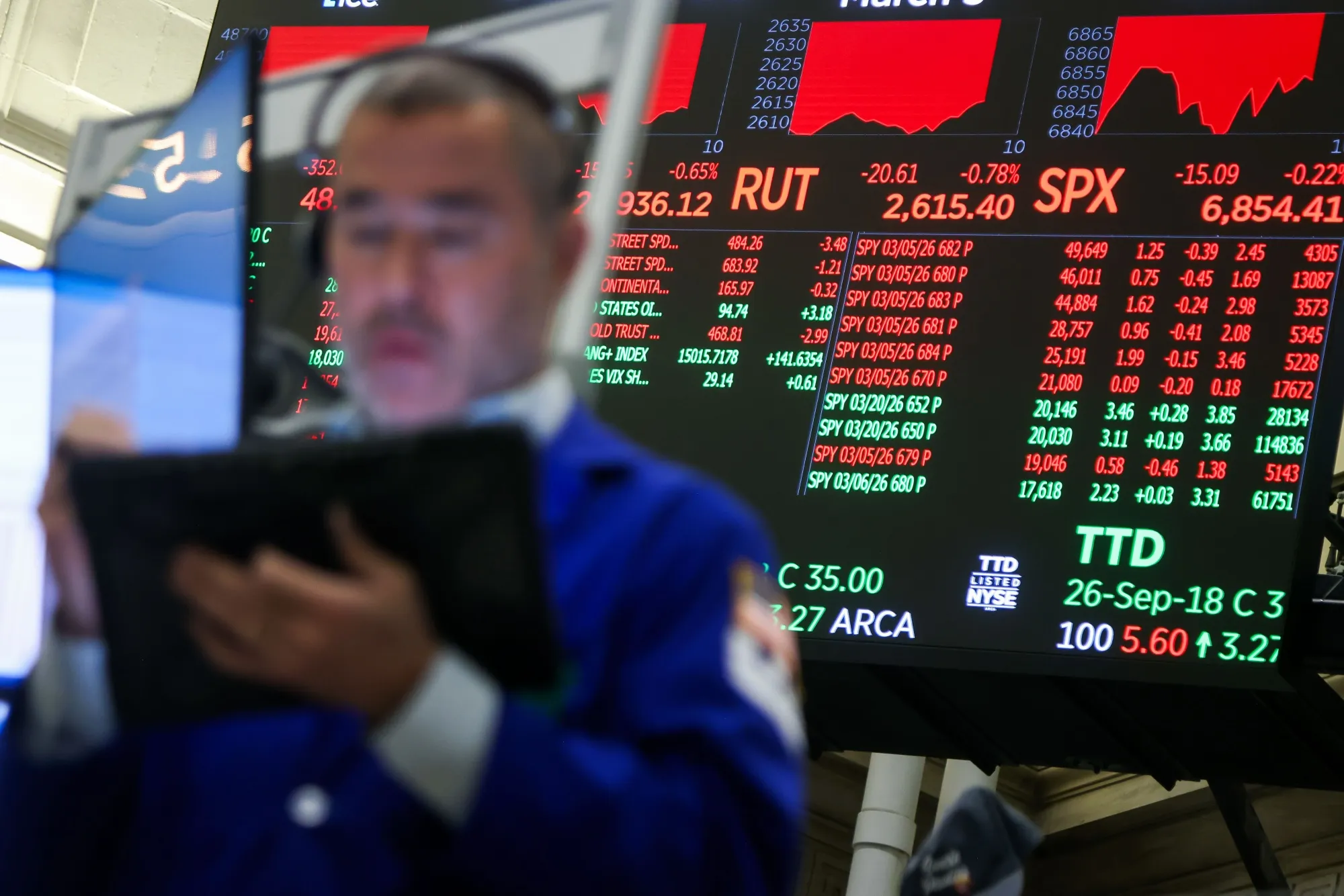
Six trillion dollars (around 89 million in BTC) in global equity value has been erased since the war in Iran began. Brent crude touched $120 a barrel Monday morning — its biggest single-day dollar gain in the history of futures trading. Bonds, which are supposed to go up when the world falls apart, went down instead. And the Federal Reserve, which was supposed to cut rates this year, may now be trapped in a position where it can’t cut anything at all.
Japan’s Nikkei plunged 5.2%. South Korea’s KOSPI triggered a circuit breaker at nearly 8% down. Taiwan fell 4.8%. Every European index was red. Dow futures dropped 800+ points before the bell. Only 47 of 503 S&P components were green. The only market in positive territory on Earth: Norway, an oil exporter, up 0.1%.
Why Bonds Broke
In a normal crisis, money flows into Treasuries. Yields go down. Bonds act as a shock absorber. That’s what happened after 9/11, Iraq, and early Ukraine. It didn’t happen this time. The 10-year yield rose to 4.17%. The 2-year jumped 4 basis points. Bonds from Tokyo to Frankfurt sold off. Bloomberg called it the worst bond week in nearly a year.
Investors aren’t buying Treasuries for safety because they’re more afraid of inflation than the war. Oil at $120 moves the price of everything that gets transported, manufactured, heated, or grown. When inflation expectations spike, bonds lose value — the fixed payments they promise are worth less in real terms.
Everyone’s reaching for the 1973 comparison. But here’s what they leave out: in 1973, the U.S. had just abandoned the gold standard two years earlier. The Fed had spent the prior decade expanding the money supply to finance Vietnam and the Great Society. The oil shock didn’t create the inflation — it revealed it. The money had already been printed. The embargo just forced prices to catch up. Sound familiar?
The Fed Built This Trap
Before the war, markets had priced in two rate cuts this year. That’s over. Bond options show some traders betting the Fed may not cut at all. Some analysts are floating an “insurance hike.”
Wall Street is treating this like the Fed got ambushed. It didn’t. The Fed spent 15 years at or near zero rates, printed $4.8 trillion during COVID, enabled $30+ trillion in government debt, and told everyone inflation was “transitory” while the money supply expanded 40% in two years. Now a real supply shock has arrived and there’s no room to maneuver — not because the war surprised them, but because every lever had already been pulled and every dollar already debased.
Friday’s jobs report showed more cuts than hires. Consumer confidence is fragile. Energy is spiking into a new 15% global tariff. The Fed can keep rates high and risk recession, or cut and risk inflation. It can’t do both. That’s stagflation — and it’s not a surprise. It’s the predictable result of suppressing the price of money below its natural rate for 15 years. The war didn’t create the fragility. It exposed it.
Pricing A Long War
The market is no longer pricing a short war. Mojtaba Khamenei (hardliner, IRGC ties, no incentive to negotiate) killed that hope. Araghchi rejected a ceasefire on Meet the Press. Israel says it needs three more weeks. Three more weeks of Hormuz shut means three more weeks of oil above $100, supply chains breaking, and inflation building into the system in ways that take months to unwind after the shooting stops.
But zoom out and the market is saying something bigger. $6 trillion gone. Bonds failing as a safe haven. The Fed paralyzed. The reserve half empty. Government debt at $36 trillion. The dollar’s purchasing power eroding in real time. And the only response on the table is: release reserves that were already spent, promise rate cuts that can’t happen, and hope the war ends before the math catches up.
This is not a crisis caused by the war. This is a crisis revealed by it. Fifteen years of cheap money, bottomless borrowing, and monetary manipulation created a system that looked stable as long as nothing went wrong. Something went wrong.
Bitcoin: The Asset Outside The System
The asset designed for exactly this moment, scarce, decentralized, outside central bank reach, immune to money printing, impossible to drain for political convenience, is Bitcoin. Whether it moves up or down this week is irrelevant. The thesis is simple: when every institution that was supposed to protect the value of your money has already spent, printed, or debased it away, what’s left? An asset nobody can print more of.
And history keeps reinforcing the same lesson. Wars are almost always financed through money printing. Governments issue debt, central banks absorb it, and currencies slowly lose purchasing power as the cost is pushed onto the public through inflation. Austrian economists have long argued that fiat money enables this cycle, making large-scale, prolonged wars financially possible in the first place.
We’re already seeing the consequences play out in real time. As conflict escalates in the Middle East, citizens in countries like Iran have rushed to move wealth out of local currencies and into Bitcoin and crypto as internet outages and capital controls spread. When trust in institutions breaks down, people look for money that cannot be frozen, confiscated, or inflated away.
That’s why many Bitcoin advocates summarize the idea simply: fiat is war, Bitcoin is peace. Fiat systems allow governments to finance conflict through endless issuance. Bitcoin operates under the opposite principle, a fixed supply, transparent rules, and no central authority capable of printing more to fund the next crisis. In a world where states continue to debase currencies to finance war, the existence of a neutral, scarce monetary network may be one of the most important financial inventions of the modern era.